When you buy something through one of the links on our site, we may earn an affiliate commission.
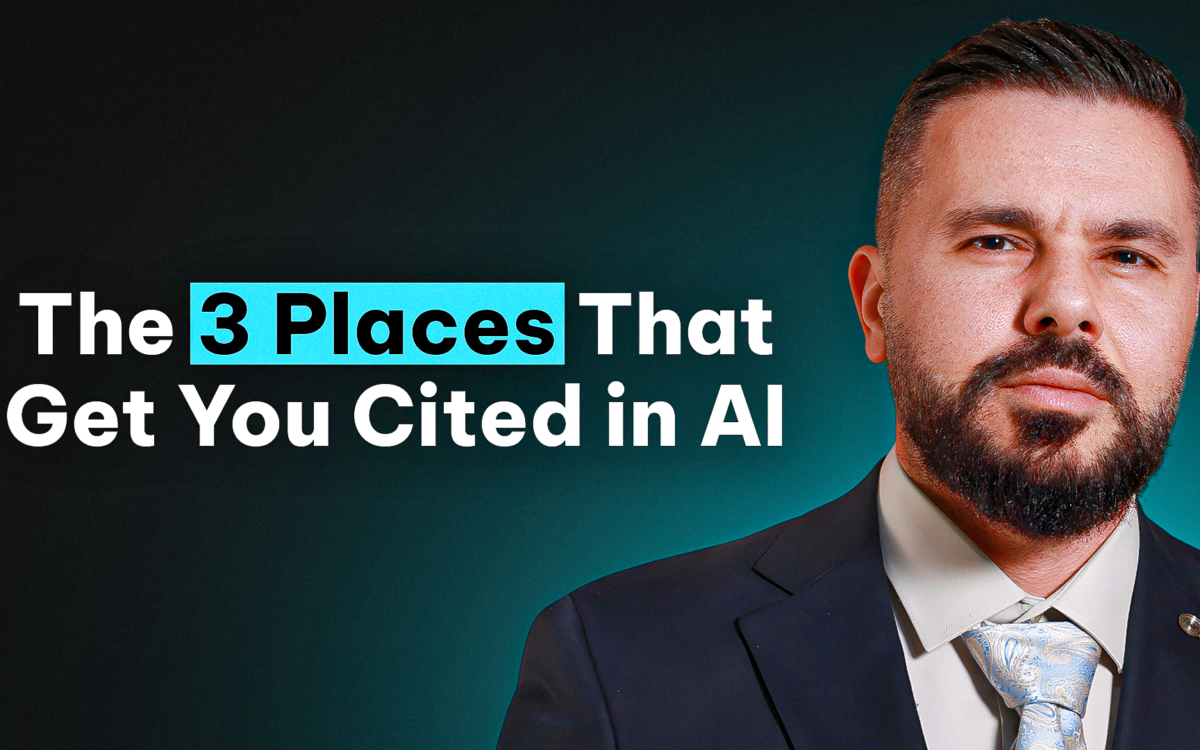
In this episode, Besmir Bregasi and I discuss what appears to influence whether brands get cited in ChatGPT, Google AI Overviews, and other LLM-driven search experiences in 2026. As the founder of ZeroRank, Besmir has access to visibility data across brands, locations, prompts, and platforms, offering insight into where companies should focus their efforts.
We explore why Reddit, X, YouTube, niche sites, editorial mentions, and fresh discussions may matter more than many site owners expect, along with the on-site factors that still count and how ZeroRank measures results that can vary from user to user. Besmir explains how he grew ZeroRank from an idea to mid-six figures in ARR after using AppSumo as an early customer acquisition channel.
Watch the Full Episode
The Shift From SEO to AEO
Besmir’s career started with SEO nearly 20 years ago. He then spent roughly 15 years focused heavily on paid advertising and affiliate marketing before returning to organic visibility through what is now often called AEO, or answer engine optimization.
That path gave him an interesting perspective on timing. Besmir believes the current shift toward AI-driven discovery resembles earlier periods in digital marketing, when a new channel offered big opportunities and relatively little competition. His earlier career also gave him experience scaling online communities and events:
- A small affiliate marketing forum grew into what he described as the largest internet marketing forum online at the time.
- That community later developed into an in-person conference business.
- The event eventually reached roughly 6,000 attendees.
- The conference expanded to three locations worldwide before the company was sold.
When LLM traffic began growing, Besmir saw another opportunity that he felt was early enough to justify going all in. That led to ZeroRank.
The Off-Site Signals Driving LLM Visibility
The most important theme from ZeroRank’s data is the weight Besmir sees being placed on off-site activity. He said LLM visibility is heavily influenced by places where people discuss, cite, review, or react to a brand.
This matters because a company can control nearly everything it publishes on its own domain. Third-party discussions offer a different signal because they come from sources the brand can't control. Among the signals Besmir watches are:
- Whether the brand appears in active user-generated discussions.
- How quickly people respond to newly published material.
- Whether a piece of content attracts comments, likes, links, or shares.
- How closely the source relates to the topic or niche surrounding the brand.
This matters for site owners who put most of their energy into their own domain. On-page work still has a place, while the larger opportunity may be creating enough attention elsewhere that LLMs repeatedly encounter the brand across sources they trust.
The Freshness Advantage Across AI Search
Of all the factors Besmir discussed, he emphasized freshness most. In ZeroRank’s observations, recent, valuable content can sometimes carry more influence than a large archive of older mentions.
He has seen brands with extensive online histories gain less traction when that material is dated or low quality. Fresh content that gets immediate interaction seems to send a different signal. A useful example came from an experiment ZeroRank ran on X:
- The team published content they believed had genuine value.
- Because the account didn't have enough reach to generate large initial exposure, they promoted the post with X ads.
- Paid visibility created the first wave of views.
- The post's quality drove engagement from those viewers.
- That engagement then led to additional organic exposure beyond what the team had paid for.
The lesson wasn't that brands should pay to promote every post. The more interesting point was the sequence: fresh material gained exposure, people reacted quickly, and the platform generated additional reach as a result. Besmir sees that pattern across multiple channels.
The Three Platforms Carrying the Most Weight
When Jared asked which sources appeared most influential in ZeroRank’s client data, Besmir repeatedly returned to three platforms: Reddit, X, and YouTube. Each platform works differently, so simply placing a brand name on all three is unlikely to have the same effect as earning meaningful exposure.
Reddit remains one of the major citation sources in ZeroRank’s data, even after some decline from its earlier prominence. Besmir said factors around a thread's quality and history appear to matter when evaluating how influential that discussion may become.
For brands, that means valuing participation in credible, relevant conversations more than posting a large amount of obvious promotional material.
X
X allows brands to create fresh information and generate interaction quickly. Besmir’s promoted-post experiment showed how paid exposure can sometimes spark an account when it lacks a large audience.
The goal isn't exposure alone. A post still needs to attract enough genuine interest for people to interact with it after seeing it.
YouTube
YouTube is another major source in ZeroRank’s data, with Besmir specifically noting its influence around Google AI Overviews. Fresh videos that attract comments, likes, and engagement shortly after publication appear especially interesting from an LLM visibility perspective.
That gives video a second role beyond generating direct views. A useful video can also become a third-party source that connects a company with a topic.
The Value of Niche Editorial Mentions
User-generated content received most of the attention in the interview, but it wasn't the only category that mattered. Besmir also sees LLMs pulling information from editorial sites, blogs, news sources, and websites tied closely to a particular niche.
A mention from a relevant industry site may therefore carry more meaning than a random citation from a domain with little connection to the subject.
Besmir also shared one notable observation regarding LinkedIn. When he looks at the sources citing ZeroRank clients, LinkedIn doesn't appear near the top compared with Reddit, X, YouTube, and niche editorial sites.
That doesn't make LinkedIn irrelevant as a marketing platform. It simply means ZeroRank’s current client data hasn't shown it carrying the same citation weight as the three primary channels discussed in the interview.
Seeing the SEO Connection Behind LLM Citations
Traditional SEO is far from irrelevant in this model. Besmir still sees search engines and conventional websites as part of the information layer LLM systems may draw from when forming responses.
He gave a rough illustration in which user-generated content might account for 60% to 70% of the influence, with the remaining 30% coming from other websites and sources connected to traditional search. Those percentages were presented as an approximate way to explain the relationship, rather than a fixed formula.
That creates a useful connection between SEO and AEO:
- Editorial coverage can support both search visibility and AI visibility.
- Niche authority still matters when LLMs look beyond social platforms.
- Search engines can function as part of the information retrieval layer used by AI systems.
- SEO work may continue producing value even when the final interaction happens inside an LLM rather than on a Google results page.
For site owners, this means abandoning SEO to chase AI citations would be an extreme response. The two channels overlap, even if off-site discussion appears to have gained greater importance.
Maximizing Local Search Opportunity

One of the interview’s most interesting examples involved a vacation rental company targeting a specific city and country. The business faced established competitors in Google and struggled to outrank them through conventional search.
Instead, the company focused on conversations taking place in the relevant language and geographic community. It posted across local Reddit communities and X discussions in Italian. According to Besmir:
- The niche had relatively low competition inside LLM results.
- The company increased mentions through Reddit and X.
- Within roughly one week, it became the number one LLM suggestion for the targeted niche.
- Besmir said the increased AI visibility produced several clients within about two weeks.
The case suggests local businesses may have opportunities that look different from conventional local SEO. Language, location, platform selection, and topical relevance can all influence which sources an LLM sees when answering a geographically specific query.
It also shows how competition levels matter. In a lightly contested market, a relatively small amount of fresh activity may have a noticeably larger effect.
On-Site Foundation for AI Visibility
When the conversation shifted to changes site owners can make on their own domains, Besmir described on-site work as a baseline requirement rather than the main growth lever. A technically clear site helps LLM systems access and interpret information, while those changes alone are unlikely to create significant visibility. The core items he mentioned included:
- A clear FAQ section
- Logical H1 and H2 structure
- Questions followed directly by clear answers
- Fast page loading
- Schema markup
- Topical depth
- LLMs.txt
- A site structure that is easy for automated systems to parse
Besmir’s point was that these items reduce technical friction. Once the basics are handled, investing endless hours tweaking page structure may produce less impact than earning relevant mentions elsewhere.
He also noted that off-site signals are harder for a company to manipulate directly. That makes third-party references a potentially useful quality signal for systems deciding which brands deserve to appear in a response.
The Measurement Approach Behind ZeroRank
One challenge with LLM tracking is personalization. Two people can enter similar prompts and receive different answers based on geography, history, device, account information, or other variables.
ZeroRank addresses that problem through scale rather than treating one response as definitive. Besmir said the platform runs queries across large numbers of accounts and combinations, then looks for recurring patterns. The process includes variations such as:
- Different geographic markets
- Different devices
- Accounts with history
- Accounts without history
- Repeated queries across many instances
Rather than focusing entirely on whether a company is first or second in one individual response, ZeroRank creates an average visibility baseline. A company can then make changes, repeat the measurements, and see whether that baseline moves up or down.
That makes the data more useful for experimentation. The goal is to find directional change and repeatable patterns, not pretend every LLM response will be identical.
The Three-Month ZeroRank Launch
ZeroRank itself was built under an aggressive timeline. After Besmir and his co-founder Kelvin [Çobanaj] decided to pursue the opportunity, they gave themselves three months to produce the first version.
Kelvin, who had previously served as CTO of the conference company Besmir helped build, left a highly paid CTO role at a crypto company and focused on the project full-time. Besmir also shifted his attention away from other products. Their early development process included several notable milestones:
- The team created the first product version in roughly three months.
- ZeroRank tested its data using brands the founders already owned.
- The company used Reddit posts to attract its earliest testers.
- That process generated its first roughly 100 users.
- Besmir then set a goal of reaching 1,000 customers as quickly as possible.
A key product decision involved how ZeroRank collected information. Besmir felt relying solely on standard LLM APIs wouldn't provide an accurate enough picture of how brands appeared across countries, so the team developed another method to capture geographic differences.
That mattered because the same brand can appear differently in Italy, Germany, the United States, and other markets.
The AppSumo Bet and Its Tradeoffs
Once ZeroRank had its first users, Besmir wanted a much larger group to validate the product. AppSumo became the acquisition channel the team used to accelerate that process.
The results came faster than expected. Besmir said ZeroRank passed 1,000 customers rapidly, became one of AppSumo’s top-selling products during its first month, and received five-star reviews at the time of the interview. He also shared several warnings for SaaS founders considering the same approach:
- A lifetime deal works better when the underlying product is already good enough to retain long-term usage.
- An established SaaS company risks upsetting monthly customers if new users receive lifetime access for a much lower effective price.
- Lifetime customers still require support long after their one-time payment.
- Founders need to model ongoing product and infrastructure costs before selling permanent access.
- High sales volume can quickly create a large customer support burden.
- Fast responses and positive reviews can affect how visible a product becomes inside AppSumo.
Besmir doesn't view the campaign primarily as a profit source. ZeroRank priced the offer around break-even and, by his estimate, may lose a small amount on those users over time.
He treats that cost more like marketing spend. The payoff comes from getting a large group of people into the product, collecting feedback, building awareness, and creating referrals that can later produce recurring customers.
Next Phase of ZeroRank Growth
By the time of the interview, ZeroRank had been around for a little more than a year, while its major customer acquisition push had begun only several months earlier. Besmir said the company had reached mid-six figures in ARR. The team also expanded rapidly during the AppSumo period:
- ZeroRank went from two people to six in roughly three months.
- New subscription customers were arriving even without active promotion of the standard monthly plans.
- Some users discovered the product through third-party blogs and other mentions.
- Agency owners and people with sizable audiences began discussing the tool on their own.
The next stage aims to increase the percentage of recurring customers. Besmir plans to use channels including SEO, paid ads, podcasts, editorial outreach, case studies, referrals, and affiliates.
ZeroRank is also using free AI credits as a referral incentive. Users can invite friends and receive additional credits when those referrals sign up, encouraging current customers to spread the product.
Given Besmir’s long history in affiliate marketing, he also sees a more formal affiliate program as a likely channel for the company. He discussed placing ZeroRank on major affiliate networks so marketers can promote it directly.
Final Thoughts
The biggest takeaway from Besmir Bregasi’s ZeroRank data is that LLM visibility is becoming a broader marketing problem than traditional on-page SEO. Your site still needs to be technically clear and useful, but many signals influencing citations appear to come from conversations happening elsewhere.
Freshness is central to that process. Recent Reddit threads, active X posts, new YouTube videos, niche editorial mentions, and rapid engagement can give LLM systems new evidence connecting a brand with a topic.
For publishers and online business owners, treat AI visibility as an ongoing experiment, not a fixed formula. Establish a baseline, make changes, measure movement, and invest in the channels producing results.
Publishing another article may help, but creating something worth discussing on Reddit, X, YouTube, or a respected niche site may have a greater effect on whether an LLM mentions your brand.
Links & Resources
Related Posts





Want to learn step-by-step how I built my Niche Site Empire up to a full-time income?
Yes! I Love to Learn
Learn How I Built My Niche Site Empire to a Full-time Income
- How to Pick the Right Keywords at the START, and avoid the losers
- How to Scale and Outsource 90% of the Work, Allowing Your Empire to GROW Without You
- How to Build a Site That Gets REAL TRAFFIC FROM GOOGLE (every. single. day.)
- Subscribe to the Niche Pursuits Newsletter delivered with value 3X per week
My top recommendations