When you buy something through one of the links on our site, we may earn an affiliate commission.
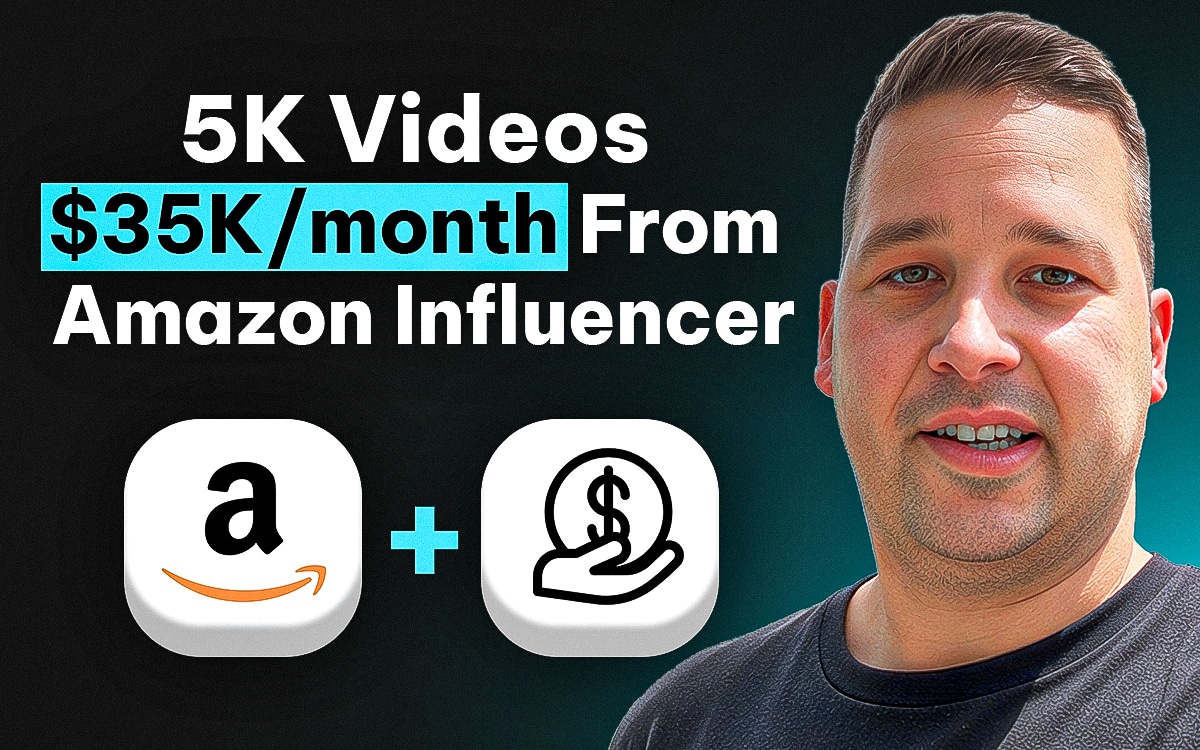
In this week's episode of the Niche Pursuits Podcast, John Muscarello and I discuss how he built an Amazon Influencer business generating roughly $25,000 to $30,000 per month. His journey started with a commitment to publish 500 videos before judging the opportunity.
Today, John has nearly 5,000 videos and a much more selective strategy. He shares how he researches products, evaluates competing videos, uses Creator Connections, and decides which products are worth purchasing himself.
Watch the Full Episode
Building an Amazon Business Before Becoming an Influencer
John's path into the Amazon Influencer Program started years before he recorded his first product review. Around 2017 or 2018, John began pursuing ways to make money on his own after deciding he no longer wanted an employer controlling how much he could earn.
John says he made about $20,000 during his first year flipping furniture on Facebook Marketplace. From there, he moved through several Amazon business models that taught him how products, sales, and the Amazon platform worked.
His progression included:
- Flipping used books sourced from thrift stores
- Moving into bulk books and leasing a warehouse
- Hiring employees to support the operation
- Switching toward merchant fulfillment during COVID
- Moving from books into online arbitrage
- Building a network of other Amazon sellers
The warehouse couldn't have been worse. John signed the lease the same day COVID disrupted the business, and Amazon temporarily prioritized items it considered necessary, forcing him to rethink fulfillment and sourcing.
Online arbitrage offered another direction, though John eventually grew concerned about that model's risks too. Then he noticed a friend making around $10,000 per month through the Amazon Influencer Program. That caught his attention.
Committing to 500 Videos Before Judging the Opportunity
John didn't enter the Influencer Program expecting immediate results. Instead, he made himself a simple commitment: publish 500 videos before deciding whether the model was worth pursuing.
He wanted enough volume to evaluate the process, rather than quit after a handful of videos. His first commission was only $0.27, yet earning that amount with roughly 10 videos showed him that the concept could work at a larger scale.
The early progression happened quickly:
- His initial target was 500 videos.
- He estimates he completed those first 500 within roughly 30 days.
- After his first year, he had around 1,000 videos.
- He added roughly another 2,000 during the following year.
- His current library sits just under 5,000 videos.
As the library expanded, monthly earnings moved through approximately $500, $1,000, $1,500, and $3,000. The growth convinced him that Amazon Influencer could become more than a side project.
By around 2024, he was putting substantial time into the Influencer business and moving away from online arbitrage.
Shifting From Video Volume to Product Selection
The strategy that helped John build his account isn't the same as the one he uses now. His earlier approach revolved heavily around finding as many things as possible to review.
He reviewed items in his house, his parents' house, friends' houses, and even Airbnbs. At that stage, more videos meant more opportunities to earn commissions. Today, John is far more selective.
Rather than asking, "Can I make a video about this product?" he's interested in whether the product already has enough demand to justify the time and money required to create the review. His current product criteria include:
- Roughly 500 to 1,000 or more monthly sales
- An active Creator Connections opportunity when possible
- Existing videos that leave room for a better review
- A product he can demonstrate through genuine use
- Enough commission potential to justify purchasing it
- A manageable amount of filming and editing
That distinction changes the business economics. Instead of publishing a huge number of videos and waiting to see which ones produce commissions, John is putting more effort into selecting products with favorable economics before filming.
Researching Products Before Spending Money
Product research has become one of the most important parts of John's workflow. He uses Oink, Viral Vue, and Keepa, though he notes that you don't necessarily need all three.
Viral Vue helps him scan Amazon search results and identify products connected with Creator Connections. Oink provides additional data and analytics, while John also likes its messaging functionality.
Keepa serves a slightly different purpose because John's familiarity with it goes back to his Amazon seller days. He uses historical data to evaluate questions such as:
- How long has the product been selling on Amazon?
- Has its price remained relatively stable?
- Is today's price temporary because of a sale?
- What could the commission look like when the price returns to normal?
- Does the product have enough history to suggest the seller is likely to remain active?
John gave the example of seeing a product listed for more than 900 days. That history can offer more confidence than a brand-new listing with little evidence of staying power.
He also prefers researching directly on Amazon rather than relying solely on the Creator Connections interface. Browser extensions can layer campaign information onto regular Amazon results, giving him product images, sales information, existing videos, and campaign opportunities in one research process.
Watching Competing Videos Before Choosing Products
One of the most time-intensive parts of John's strategy is also one of the simplest: he watches competing influencer videos.
No fully automated scoring system that determines whether a product has weak existing videos. John has watched thousands of them, and that experience allows him to scan a video for 10 or 20 seconds, jump to relevant sections, and quickly judge what is missing.
He's particularly interested in products where existing creators haven't demonstrated genuine use. A product that still has plastic attached or hasn't been put through its intended use can signal an opportunity. John also looks for unanswered buying questions, such as:
- How many times can a portable charger recharge a phone?
- How does a particular device charge?
- Can an accessory attach to a backpack?
- What configurations or colors are available?
- Does the product perform differently than the listing claims?
- Is there a use case nobody else demonstrates?
This means his competitive advantage isn't necessarily a more polished production. Often, it comes from noticing the question a potential customer still has after watching everyone else's videos.
Purchasing Products Instead of Relying on Free Samples
A major shift in John's business has been his willingness to purchase the products he wants to review. Previously, he relied much more heavily on free products from brands through Creator Connections, earning commissions before reselling many of those items on Facebook Marketplace.
That approach created several challenges:
- At one point, John estimates he received roughly 200 to 400 free products per month.
- Reselling products created another workload alongside researching, filming, and uploading videos.
- Preserving an item's resale condition could limit how thoroughly he demonstrated it.
- Products that require filling, assembling, charging, or extended testing are harder to review properly when resale value is a priority.
John now buys roughly 70 to 100 products per month, giving him greater control over his workflow. More importantly, buying the products lets him use them during filming without worrying as much about keeping them in nearly new condition.
Treating Creator Connections as the Main Revenue Driver
Creator Connections now sits at the center of John's business. He estimates that approximately 80% of his income comes through Creator Connections, with the remaining 20% spread across standard Amazon commissions, brand deals, reselling, and related revenue.
The difference in commission rates helps explain that focus. John says Creator Connections can pay at least a 10% commission, compared with Amazon’s base commission, which he says is usually around 1% to 3%.
That makes product selection especially important. John's current process centers on:

- Finding products with proven sales demand
- Identifying products participating in Creator Connections
- Evaluating existing influencer competition
- Purchasing promising products himself
- Creating a more useful review
- Earning the higher campaign commission when sales occur
Based on his own calculations, John says he typically needs about six to 10 sales to recoup the money he spends purchasing a product. Careful research before buying is what makes that approach sustainable for him.
Creating Useful Videos Without Heavy Editing
Nearly 5,000 videos might suggest a complicated production process, yet John's editing approach is surprisingly simple. He focuses his time on demonstrating the product and answering useful questions, not creating highly produced videos.
His production process reflects that philosophy:
- Most videos are filmed in a single take with little to no editing.
- When multiple scenes are needed, he simply combines them in iMovie.
- He doesn't rely heavily on transitions, graphics, or extensive post-production.
- Video length depends on the product and the quality of competing reviews.
- A two- or three-minute review may be enough when existing videos leave obvious gaps.
John evaluates each product individually rather than following a fixed video template. If competing reviews miss an important feature, question, or use case, he focuses his video on filling that gap.
Organizing a 150-Video-Per-Month Workflow
John estimates that he currently makes around 150 videos per month, though the number varies with his schedule. Keeping that pace requires separating research, filming, and other business tasks rather than constantly switching between them.
He built a dashboard with Claude to track products through the process. Once he decides to buy something, it enters the purchasing stage and remains in his system until it's ready for filming.
He also uses AI to create a roughly one-page outline from Amazon product information before recording. That gives him relevant information to reference without turning the video into a heavily scripted production. A typical week might involve:
- One or two dedicated filming days
- Uploading videos around the same time they're filmed
- A separate day devoted largely to product research
- Other days for brand deals and administration
- Listing excess products on Facebook Marketplace
- Working on social media and his podcast
Batching lets him maintain a strong publishing rate while keeping post-production relatively light.
Being Selective About Brand Deals
Brand deals sound appealing because they provide money upfront, but John warns the economics aren't always as attractive as they seem. He doesn't actively pursue most of his deals. Brands generally approach him through email or Instagram.
Early on, John was willing to accept very small deals, sometimes for $5 or $10, because he wanted experience and more opportunities. These days, he's far more selective.
A $20 or $50 deal can involve numerous emails, shipping updates, requests for the completed video, sending links, and payment follow-ups. If the product has little sales history, there may also be very little commission revenue afterward.
Higher-value arrangements can make the effort more worthwhile. John mentioned receiving a roughly $1,200 television for free as an example of a deal with much more compelling economics.
Using YouTube as a Secondary Revenue Channel
John also publishes most of his Amazon review videos to a separate YouTube review channel. That creates another source of visibility and gives brands a way to discover his work outside Amazon.
It can also generate off-site Amazon affiliate commissions when someone watches a YouTube review, follows his affiliate link, and purchases the product. Since he sends traffic to Amazon himself, John says those commissions can come at a higher rate.
The direct affiliate income isn't close to what his on-Amazon operation produces. John estimates the YouTube channel brings in around $400 to $500 per month from affiliate activity after roughly two years of building it.
The channel still has strategic value beyond those commissions. It gives his existing videos another place to work without requiring an entirely separate content library.
Working With Less Amazon Reporting Data
One challenge John faces is determining precisely which videos and products are producing results.
Amazon has reduced some of the reporting information available to influencers. John explained that Creator Connections previously let creators enter an ASIN and see associated sales information, giving them a clearer picture of product performance.
More recent changes removed some of that visibility. According to John:
- A product may need four sales in a single day to appear in certain daily reporting.
- A single sale can therefore be difficult to identify at the individual product level.
- Looking across a longer period can provide more clues about which products are moving.
- Creator Connections reporting has become less informative than it used to be.
This makes John's front-end research even more consequential. When post-publish feedback is limited, selecting products with meaningful demand and weaker competing content before spending money becomes a bigger part of risk management.
Doubling Down After Amazon Cut Some Commissions
John believes there's still room for people entering the Amazon Influencer Program in 2026. He points to an Amazon commission reduction around April as an example of why changes can create new openings. When Amazon reduced certain commissions, many influencers worried about what it meant for the program.
John reacted differently. He focused more heavily on Creator Connections because those campaign commissions remained central to his strategy. John says that if he were starting again today, he would put product research first rather than taking the broad, volume-focused approach he used early on.
- Spend more time researching products before filming.
- Prioritize products that already demonstrate meaningful sales.
- Look closely at Creator Connections campaigns.
- Study competing videos for missing information.
- Use each product enough to demonstrate it properly.
- Favor useful content over elaborate production.
John believes better product selection lets today's creator produce fewer videos while earning more from the ones that succeed. That's a substantial departure from his earlier strategy of filming nearly anything he could access.
Keeping Podcasting Separate From the Main Income Engine
John also co-hosts the Side Hustle Experiment Podcast. The show began around Amazon selling before expanding into different ways people make their first roughly $1,000 to $5,000 per month through side businesses.
Interestingly, John doesn't present podcasting as an easy way to make money. After more than two years, he says the podcast itself isn't generating much income. He continues because the benefits are different:
- It gives him opportunities to meet other entrepreneurs.
- He can ask business owners questions he personally wants answered.
- Conversations reveal downsides that aren't obvious from success stories.
- Recording turns conversations into public content.
- Exposure to other business models helps them decide which opportunities aren't worth pursuing.
After interviewing roughly 100 to 120 businesses, John has repeatedly found that attractive business models often have hidden tradeoffs. A resale story about buying something for $100 and selling it for $1,200 sounds compelling until a conversation reveals the more typical outcome: buying for $100 and selling for $300.
That perspective also mirrors his Amazon Influencer strategy. The headline opportunity matters less than the economics underneath it.
Final Thoughts
John started by committing to 500 videos and eventually built a library of nearly 5,000. That volume helped establish his business, while his strategy has since become far more selective.
Today, he prioritizes products with proven sales, Creator Connections campaigns, and opportunities to create better videos than existing competitors. With Creator Connections producing around 80% of his income, his experience shows why thoughtful product selection has become such a major part of his Amazon Influencer business.
Links & Resources
- Get John's Amazon Influencer Guide
- Watch The Side Hustle Experiment on YouTube
- Connect with John on Instagram
Related Posts






Want to learn step-by-step how I built my Niche Site Empire up to a full-time income?
Yes! I Love to Learn
Learn How I Built My Niche Site Empire to a Full-time Income
- How to Pick the Right Keywords at the START, and avoid the losers
- How to Scale and Outsource 90% of the Work, Allowing Your Empire to GROW Without You
- How to Build a Site That Gets REAL TRAFFIC FROM GOOGLE (every. single. day.)
- Subscribe to the Niche Pursuits Newsletter delivered with value 3X per week
My top recommendations