When you buy something through one of the links on our site, we may earn an affiliate commission.
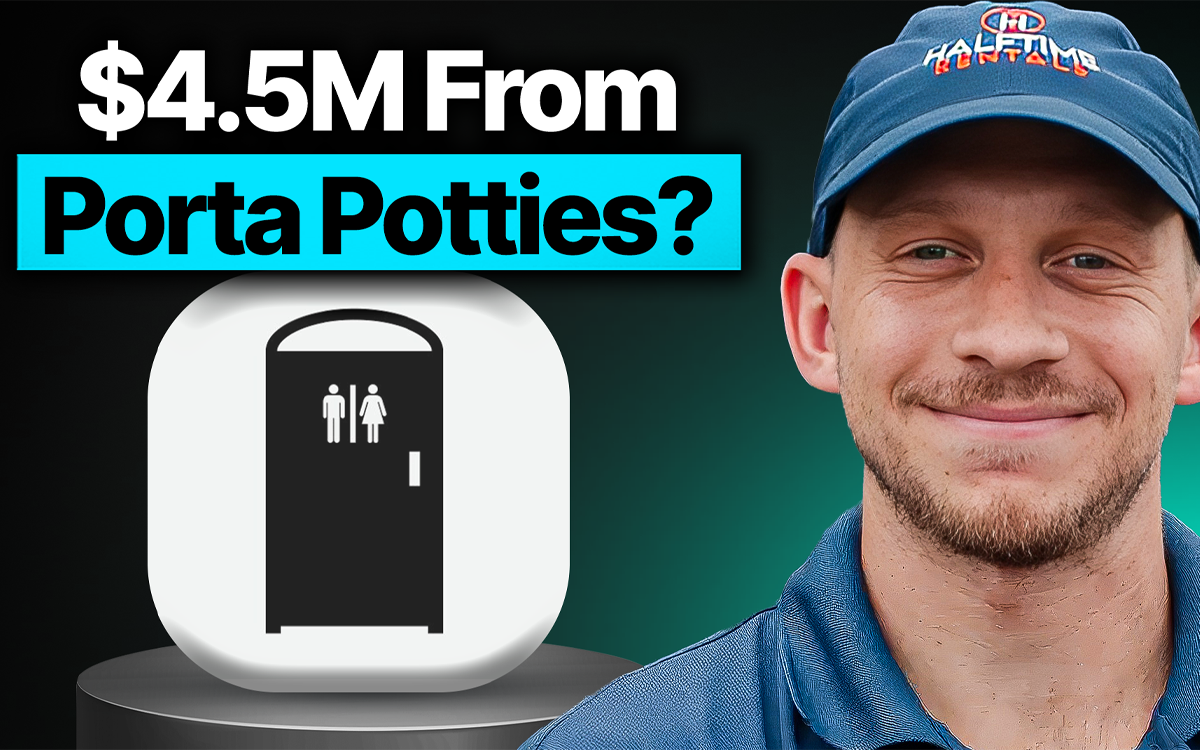
In this week’s episode of the Niche Pursuits podcast, Chad Howard and I discuss how he left a decade-long corporate career and built Halftime Rentals into a fast-growing porta potty rental business. It's not a flashy business, yet Chad’s story shows how a simple service company can grow quickly when the founder moves fast, serves customers well, and takes bold action.
Launched in mid-2024, Halftime Rentals is already on pace for about $4.5 million in annual revenue. The company has nearly 1,900 units under lease, 9 full-time service trucks, 15 employees, and an average EBITDA margin of around 30% over the past six months.
Watch the Full Episode
From Corporate America to Porta Potties
Chad’s path into entrepreneurship didn't begin with a lifelong dream of renting portable toilets.
He spent 10 years at Procter & Gamble, where he moved through different roles, lived in 8 states, and built a successful corporate career. For a long time, he thought that career path might be his future.
The porta potty idea first came to him through his now-business partner, Austin. Austin had been involved in blue-collar search-fund work and had looked closely at portable-toilet businesses. He saw the financials, studied the model, and kept encouraging Chad to consider launching one.
For years, Chad brushed off the idea. At the time, he was making good money and climbing the corporate ladder. Leaving that behind for a messy, hands-on service business felt like a major jump. A few things eventually changed:
- Chad reached a breaking point with corporate life
- He became more interested in owning his own company
- He shadowed existing porta potty businesses
- He saw that the model had clear demand
- He realized the business did not need to be reinvented, only run better
By early 2024, Chad had raised money from friends and family. By the summer, he had quit his job, moved to Charlotte, and launched Halftime Rentals.
Going All in From Day One
Many entrepreneurs build on the side before leaving their full-time job. Chad took a different route. He quit first, raised capital, moved cities, and gave the business his full attention from day one. That approach carried risk, and he knew it.
For Chad, the decision came down to two main factors. First, he knew his own personality. He didn't want one foot in corporate life and one foot in entrepreneurship. Second, the business required local, hands-on attention.
This wasn't a website he could work on at night from another state. He needed to be in Charlotte, meeting with customers, delivering toilets, resolving truck issues, and building routes during normal business hours.
His decision was also shaped by the advice he received. When he talked with people older than him, especially those over 50, he kept hearing the same message. They told him to take the chance, often saying they regretted not betting on themselves earlier. That repeated advice made an impact.
The Six-Month Setup Before Launch
Although Chad made a bold jump, he didn't rush into the business unthinkingly. He spent about six months preparing before launch. During that time, he worked through the details so that once he was ready, he could move quickly. His preparation included:
- Choosing the right software
- Shadowing other portable toilet operators
- Learning what he liked and disliked about the industry
- Setting up the website
- Choosing suppliers
- Planning truck and toilet purchases
- Building enough confidence to act quickly
Once he made the final decision, he was able to place orders and set the company in motion within about a week. That preparation mattered. Later, when a major crisis created sudden demand, Chad already had the mindset and supplier knowledge needed to move at speed.
The Early Days Without a Safety Net
Chad came from Procter & Gamble, a company with structure, process, and support. Then he entered a business where every day looked different. Some days he was in a truck. Other days he was cold-calling, emailing prospects, visiting job sites, fixing equipment, or trying to figure out who to hire.
The hardest part early on was the uncertainty. He had to create his own schedule, his own systems, and priorities. There was no department to call when something broke.
That early stretch forced him to learn by doing. He had to solve problems he had never faced before. He also had to get comfortable with the fact that a service business rarely provides a perfectly normal day.
Hurricane Helene as the Turning Point
A few months after launching, Halftime Rentals was still tiny. Chad estimates the company had about 100 toilets rented out and only one truck operating. Then Hurricane Helene hit western North Carolina.
On a Sunday morning, Chad was picking up toilets from a Carolina Panthers tailgate when he received a call from Home Depot’s corporate office. They needed portable toilets for stores in the greater Asheville area so they could open and support recovery efforts.
At first, Chad said no. Asheville was about two hours away from Charlotte. The request meant loading toilets immediately, driving into a disaster zone, and delivering them in time for stores to open the next day.
Then he reconsidered. He called back, quoted a premium price, and Home Depot accepted. That one decision changed the direction of the company. The original order was roughly 10-12 toilets per store across 4 stores. For a company with about 100 toilets, that was a huge order. The next 24 hours were intense:
- Chad and Austin loaded toilets themselves
- They delivered into Asheville with a police escort
- His phone number was now in front of Home Depot customers
- The next day, he had more than 200 voicemails
- Demand exploded from stores, restaurants, relief groups, and major retailers
Chad moved fast. He financed multiple trucks in a single day, secured 500 toilets, found a place to stage them at a community college parking lot, rented an RV, and slept on a friend’s goat farm while responding to calls for up to 20 hours a day.
It was chaotic, stressful, and full of risk. It also became the catalyst that helped turn Halftime Rentals from a tiny startup into a much larger operation.
Speed, Risk, and First-Mover Advantage
The Hurricane Helene response not only created a short-term revenue spike. It changed how Chad thinks about the business. After responding to a natural disaster only a few months after launch, large emergency orders no longer feel as intimidating.
His default response became yes. That mindset helped the company take on urgent jobs that competitors might ignore. It also helped Halftime Rentals build credibility with brokers and major retail partners.
Financially, the impact was huge. Chad said that one month allowed the company to cash flow nearly all of the assets it added during the disaster response. That included multiple trucks and hundreds of toilets.
The experience also created relationships that followed the company back to Charlotte.
Some of the brokers calling during the emergency worked with major retailers like:
- Walmart
- Target
- Home Depot
- Lowe’s
- Salvation Army-related needs
- Other large commercial accounts
After serving those customers in Asheville, Chad followed up in Charlotte. He said that Halftime Rentals had already helped them during a high-pressure moment. That opened doors.
Why a “Boring” Business Can Be Anything But Boring
Chad finds the term “boring business” funny now. From the outside, portable toilet rentals look simple. You deliver the unit, service it weekly, and pick it up when the job is done. Inside the business, the day-to-day is far more complex.
There are trucks, routes, repairs, customer complaints, emergency deliveries, scheduling challenges, and hundreds of active job sites. Chad said he can probably count on one hand the number of truly boring days he has had at Halftime Rentals.
Still, the model has clear advantages. The business already exists. Demand already exists. Customers already know they need the service.
Chad doesn't have to convince the market that portable toilets are useful. He only has to deliver the service better than competitors. That is a major part of what attracted him to the opportunity. The market also has built-in demand drivers:

- Charlotte and the Southeast continue to see construction activity
- Job sites are legally required to have portable toilets
- The product is a need, not a luxury
- More construction means more rental demand
- Customers value reliability when the service affects daily job site operations
That combination made the business simple in concept, yet highly attractive when run well.
Marketing That Makes a Utility Business Memorable
Chad credits much of Halftime Rentals’ growth to three marketing and sales engines. The first is persistent selling. Chad, his business partner, and his sales manager keep showing up, following up, and staying in front of prospects.
The second is Google Maps. Halftime Rentals is listed as open 24/7. That made a major difference during Hurricane Helene, since competitors were not listed as open on a Sunday. It still matters today.
When someone searches for portable toilet rental after 5:00 PM or on a weekend, Halftime Rentals is often the company that appears available. That creates emergency jobs, new relationships, and higher-value orders.
The third engine is brand personality. Halftime Rentals has leaned into humor and memorable merchandise. Their hats and shirts use phrases like “get shit done,” which has helped the company stand out on job sites.
That branding works because it feels authentic to the business. It gives people something to remember, talk about, and ask for. Chad said he has walked onto job sites where people already know the hats and request one. For a small part of a construction site, that kind of recognition matters.
Reviews as a Local Growth Engine
Reviews have been one of Halftime Rentals’ most important local marketing assets. Chad created a simple incentive program for drivers. When a driver gets a Google review that mentions their name, they receive a $25 Amazon gift card.
That system gives drivers a reason to ask happy customers for reviews. It also connects the review to a specific employee, which reinforces accountability and pride. Some drivers have embraced the program so much that Chad said one has earned more than $3,000 in Amazon gift cards. This system works because it benefits everyone.
- Drivers earn extra rewards.
- Customers mention specific service moments.
- The company gains more reviews.
- Google Maps visibility improves.
- The best employees get public recognition.
Chad also tracks local search performance using Local Falcon, which shows where Halftime Rentals ranks across different parts of Charlotte.
That helps him see where the company needs more reviews, photos, or activity on the Google Business Profile. The goal is simple: show up first when customers need a portable toilet rental.
Customer Service From the Driver’s Seat
Chad sees his drivers as the face of the company. Customers usually don't see Chad in the office. They see the person delivering, cleaning, servicing, or moving the toilet on-site. As a result, Chad makes it clear that drivers are customer service representatives.
That mindset has shaped the company’s culture. Drivers are encouraged to build relationships, take pride in the work, and solve problems on-site. Chad also tries to create an environment where employees enjoy their days.
He believes that when drivers are treated well, paid well, and appreciated, they put out a better product. That creates better customer interactions and, in turn, stronger reviews and repeat business.
The company also uses positive incentives. For example, Halftime Rentals performs “drop-ins,” where someone inspects a serviced toilet. When the unit meets the company standard, the driver can earn a $50 bonus for that day.
New driver training lasts about a week. During that period, new hires ride with different experienced drivers. Those trainers also receive bonuses because Chad wants them to recognize the long-term impact of setting a high standard.
Chad’s Role as the Company Scales
In the first 8 to 12 months, Chad spent most of his time in trucks. He was pumping toilets, cleaning units, picking up inventory, and making deliveries. He estimates that around 80 percent of his days involved some form of manual labor.
That has changed as the company has grown. He still gets in a truck when needed, although he now has enough drivers to spend more time on higher-level work. He estimates that getting out of the truck has given him back 2 to 3 hours per day. His current time is divided across three main areas:
- Supporting drivers and helping solve daily problems
- Training people into larger operational roles
- Selling and following up with prospects
Chad wants the business to keep running even when he steps away. That means putting people and processes in place so the company is not dependent on him for every decision. At the same time, he remains heavily involved with the team and the sales process.
The Next Stage for Halftime Rentals
Chad’s near-term goal is clear. He wants Halftime Rentals to become the largest and best portable toilet company in the greater Charlotte area. He believes the business can double or triple in the next 2 to 3 years.
For now, he's staying focused on Charlotte. He does have interest in expanding to other Southeast markets later. One idea that excites him is investing in people who want to leave corporate America and helping them launch Halftime Rentals in other cities.
That vision can wait. Right now, the focus is market dominance in Charlotte. Chad wants to win there before adding new locations or new service lines.
Lessons Chad Learned the Easy Way and the Hard Way
One thing Chad believes he got right was having a partner. His business partner, Austin, helped him through the hardest early days. Chad said he might have quit or lost momentum without someone beside him in the trenches.
That support mattered during the launch. It mattered even more during the Hurricane Helene response, when the company had to make large decisions under pressure and execute them immediately.
One thing Chad would change is moving faster on personnel decisions. He said he waited too long to let go of employees who were not the right fit for the company. He wanted people to succeed so badly that he ignored what he already knew.
Looking back, he believes the company could have reached its current level sooner with better people in the right seats earlier. That lesson is simple:
- The team sets the pace
- Delayed decisions create hidden costs
- Hope is not a hiring strategy
- Culture gets easier when the right people are in place
Final Thoughts
Chad Howard’s story is a great example of what can happen when a founder combines preparation, speed, service, and a willingness to take risk. Halftime Rentals was only a few months old when Hurricane Helene created a massive need.
Chad could have passed on the opportunity, and no one would have blamed him. Instead, he said yes, figured it out, and built momentum that changed the company’s trajectory.
The business works because the fundamentals are clear. Customers need the service, the market demand is established, and many competitors leave room for better communication, faster response times, and better customer care.
Chad didn't invent a new category. He entered an existing one and focused on doing the basics better, from answering emergency calls to rewarding drivers for great work. That approach has helped Halftime Rentals reach nearly 1,900 units on rent and a projected $4.5 million in annual revenue in under two years.
For anyone thinking about leaving corporate America, buying or building a service business, or taking a serious shot at entrepreneurship, Chad’s story offers a lot to think about.
Sometimes the opportunity isn't glamorous. Sometimes it's sitting in a blue-collar industry that others overlook. And sometimes, the difference comes down to answering the phone, saying yes, and getting the job done.
Links & Resources
- Learn more about Halftime Rentals
- Connect with Chad
Related Posts







Want to learn step-by-step how I built my Niche Site Empire up to a full-time income?
Yes! I Love to Learn
Learn How I Built My Niche Site Empire to a Full-time Income
- How to Pick the Right Keywords at the START, and avoid the losers
- How to Scale and Outsource 90% of the Work, Allowing Your Empire to GROW Without You
- How to Build a Site That Gets REAL TRAFFIC FROM GOOGLE (every. single. day.)
- Subscribe to the Niche Pursuits Newsletter delivered with value 3X per week
My top recommendations